Archive for the 'CT' Category

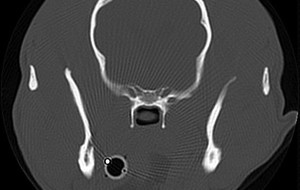
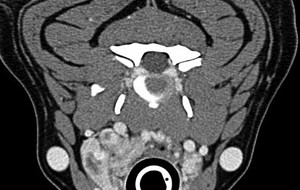
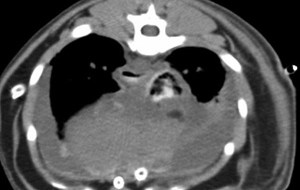
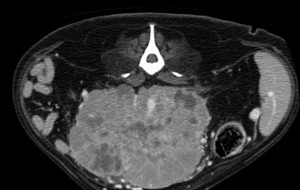
The CT/MRI society of the ACVR (American College of Veterinary Radiology) is producing a case of the month feature. This month, Dr. Kathy Beck of Angell Memorial Veterinary Center in Boston has contributed a CT case of a 14 year old M/N Himalayan cat who presented with a history of an ulcerative lesion of the nasal planum and sneezing.

We had a bit of a hiatus in KCC for the last couple of weeks with the residents preparing for written boards, and various people being away. But tonight we reconvened to do some alternate imaging cases, including CT and MR.

One case was a dog with an extra-axial, broad-based, strongly contrast-enhancing mass in the left skull base that was compressing the brain stem. On the GRE images, there was focal loss of signal from susceptibility artifact due to hemorrhage. We all agreed that the strong contrast enhancement meant the mass was extra-axial, since it would be outside the blood-brain-barrier. Normal brain does not contrast enhance, which brought up the question of whether an intra-axial mass could enhance similarly. Key points included the fact that an intra-axial mass enhances because of new blood vessel recruitment, and that higher grade gliomas enhance more strongly than low grade gliomas. The difference between an extra-axial mass and intra-axial mass would be uniformity of enhancement; gliomas tend to be heterogeneously enhancing, while meningiomas are more uniformly enhancing.

Another point that this case brought up was the different ways of looking for hemorrhage on MR. On spin-echo sequences, there are changes in intensity on T1 and T2 sequences as the blood degrades into hemoglobin derivatives over time. This often gives a mottled appearance. With GRE sequences, there is a signal void, or black area, where the degradation products from blood are located.

A second interesting case was a CT of a stray dog with mild hind limb lameness. There was a focal, soft tissue and mineral attenuating mass in the medulla of the proximal femur. It appeared to arise from the endosteum and expand into the medulla, and had a mineralized capsule with a broad base that blended back into cortical bone. There was some cortical thinning but no disruption. It had mostly benign characteristics and appeared to be arising primarily from bone. Benign primary bone tumors would include osteoma, osteochondroma, and enchondroma. This one turned out to be an osteoblastoma; very rare and luckily benign.

That’s all for this episode. KCC is winding down for the summer, but we may get to look at a few more cases before the end of the quarter.

There’s nothing better than seeing the insides of the body part you are interested in in fine detail. When you use CT a lot, you get to know about how physics affects your image quality. Once everyone has a 64 slice helical machine, we won’t have to worry about tweaking the protocols to get the most out of a study, but in the meantime, a little knowledge about helical CT physics will help you get the best scans out of your machine.

Helical CT is quite a revolution from the axial scanners that preceded it. The x-ray tube spins continuously as the table moves past it, rather than the spin/stop/table advance of earlier generations. Helical CT lets you scan much faster because of continuous table motion. The standard rotation time for a single slice helical scanner is 1 second, but newer multislice machines are down to half a second. The way to describe the table increment/slice thickness is pitch. For instance, if the table moves 10 mm during that singe rotation of the gantry, and the collimation is 5 mm, the pitch is 2. Increasing pitch allows you to scan even faster, as the gantry doesn’t have to complete a 360 degree rotation around the patient to create an image. This is a big advantage in scanning large areas, or those prone to motion such as the thorax.

So why not scan at a pitch of 5 and be done in 10 seconds? There is a limit to how far the CT can “interpolate” the spiral 3D data it collects, or average the data into a perpendicular slice or image. The gantry needs to rotate at least halfway around the patient to get data from all sides. So the upper limit of a single slice unit is a pitch of 2, but even so you will get some artifacts. A pitch of 1.5-1.7 will not result in loss of image quality, and you can use it to your advantage.

The two things you can gain with increasing pitch are

1. Increased scan speed - same volume covered in less time (less chance of respiratory motion artifact)

2. Thinner slices in the same time - If you increase the pitch, you can decrease the slice thickness or collimation, and scan the same volume in the same time.

Since thinner slices and faster scans are almost always good, use pitch to your advantage.