Archive for the 'Pet Owners' Category

The pet food recall has been the primary topic in veterinary related news for several months. The substance identified in the renal tubules of affected animals’ kidneys is melamine, used in fertilizers and plastics. The doses found in contaminated feeds are low, and it’s still unclear whether this is the primary toxin or a component of a chemical reaction that causes renal toxicity. There is mechanical blockage of the renal tubules on pathological specimens. But Barbara Powers, president of the American Association of Veterinary Laboratory Diagnosticians, told USA today that there is more to the story.

There’s something more going on than just the mechanical blockage because you wouldn’t see so much necrosis (cell death) and inflammation. But I don’t know if anyone knows for sure what the mechanism is.

Pet Connection, VIN and many national and state veterinary associations have been keeping constant watch over the latest findings, and distributing the news and advice to pet owners and veterinarians. The veterinary associations are advising the public that their veterinarian will need to perfom tests for renal disease, which may include an ultrasound examination. Enlarged kidneyBoth VIN and Pet Connection gathered information on the numbers of sick pets from across the country. It was an example of the power of the internet and its online communities working at a speed much greater than the companies involved, and disseminating information faster than the scientific journals. I hope that we will see more scientific publications in the near future that shed light on the issue. Wikipedia has a summary of the events and links to many related articles.
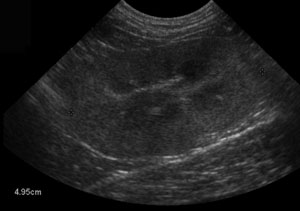
Recently, I posted on the findings reported by several radiologists on the ACVR listserv. VIN members also posted those findings, along with a report on 4 additional cases that showed increase in renal size and mild increase in cortical echogenicity (1). I had a chance to review the ultrasound exams of the two cases seen at UC Davis. One was a cat with acute renal failure. The main ultrasound finding was that both kidneys were enlarged (almost 5 cm in length) and the cortices were mildly hyperechoic (Figure 1). The second animal was a dog with previous history of renal and cystic calculi. There was no appreciable change in size or echogenicity of the kidneys.

These descriptions suggest that the findings of melamine toxicosis are similar to those of acute renal failure. It’s unclear whether the crystals cause hyperechoic cortices at this point. I encourage veterinarians who have seen additional cases to add their comments to this post so that we all have a better picture of the ultrasonographic signs of melamine toxicosis in dogs and cats.

(1) The discussion is in the Diagnostic Imaging boards, membership required for access.

Update:

Dr. Seiler included images of the left and right kidneys of the case that she evaluated:

Melamine toxicityMelamine toxicity

We all think of MR as a diagnostic tool to let us look inside the brain for signs of disease. It gives fantastic anatomical detail and contrast between tissues. Functional MR, or fMRI, is becoming a popular tool in investigating how the brain works. It measures changes in blood flow in different regions of the brain as people perform certain tasks. This information allows us to relate function and structure.

Of course, the advertising industry is very interested in how their products affect our brains. Only 50% of ads trigger any response, and they are the ones people like. Does this mean that ads we dislike are more effective? Read the whole story at Analyst Cafe.

Radio Australia’s All in the Mind recently investigated the effects of fMRI on science and journalism. Dr. Jonica Newby, a former veterinarian and broadcaster, contributed to the podcast panel discussion. One of the topics was the news generating potential of these scientific fMRI studies, since people have a fascination with the brain and how it works. Since the science is still in its infancy, what do the results mean? Are science and the media exaggerating the conclusions past the strength of the evidence? It’s worth a read or a listen.

This is a technology we’ll be hearing more about in the media and in scientific journals. It may have applications in veterinary medicine, such as in evaluating the optical pathways in dogs. But the need for general anesthesia in animal patients makes interpreting the brain scans even more difficult. Hopefully we’ll see more research on this in the future.

It’s interesting to see what people are looking for when they land on the Veterinary Radiology home page. In this post, I’ll address some of the more common questions that people want answered about our specialty.

What is a veterinary radiologist?

A veterinary radiologist is a veterinarian who has a veterinary degree, a year of internship, and a three or four year residency in radiology under their belt. Veterinary school is hard enough to get into, and attracts the best and the brightest. Those who want to specialize in radiology have to undergo another round of competitive applications, and years of training to attain specialist status. Someone who is board certified by the American College of Veterinary Radiology or the European College of Veterinary Diagnostic Imaging has had intensive training by other veterinary radiologists. Disciplines include radiology, ultrasound, Computed Tomography (CAT scan or CT), Magnetic Resonance Imaging (MR or MRI), and nuclear medicine. A specialist also has to pass an intensive written and oral exam to become board certified. Veterinary Radiologists have extensive experience in obtaining and interpreting images fof all types. Here is a link to a previous post on what a veterinary radiologist is.

Why use a veterinary radiologist?

If you have a simple problem like the flu, your GP is able to recommend treatment for it. On the other hand, if you have a more serious problem like a badly sprained ankle, your GP will either order an imaging test, like x-rays or MRI, or refer you to a specialist such as an orthopedic surgeon. In either case, a radiologist will read any imaging studies that are ordered. Experience in interpreting these images helps to find problems that might otherwise be missed, recommend further diagnostics, and optimize the treatment plan.

In veterinary medicine, GP’s provide the vast majority of services, and do a very good job of providing routine medical care. It is worth knowing that there are specialists available, such as veterinary radiologists, who have the advanced training to perform and interpret complex imaging studies. There is an insightful post on Dolittler about specialty referrals. Ask your vet if imaging referral is appropriate for your pet.

Is it veterinary radiology or veterinary diagnostic imaging?

When our specialty first started, the major technique available was the x-ray. It used radiation to produce images of the body that saw “inside” the animal in a way never experienced before. Radiographs, or x-rays of our pets give lots of important information about many different diseases, and so the specialty was named.

In the last 20 years, other technologies have allowed us to see inside the animal in different ways. Ultrasound uses sound waves, magnetic resonance imaging (MR) uses the spin of hydrogen atoms, and computed tomography (CT) uses x-rays analyzed by a computer. All of these techniques have expanded the options we have for “looking on the inside”. Proper application of these imaging techniques and interpreting the results require an advanced appreciation of physics and the radiological appearance of disease. Knowledge of disease processes in veterinary medicine has been supported and advanced by these new technologies, so there is a trend to call our specialty “Veterinary diagnostic imaging”. Imaging plays an important role in diagnosing and monitoring treatment in all species of animals. It’s not just x-rays anymore.